Designing gardens for the U.S. Northeast
Four distinct seasons with precipitation spread evenly through the year. Winter cold, freeze–thaw cycles, road salt and deer browse shape plant choice more than summer drought does.
From the Maine coast to the Pennsylvania Piedmont, Northeast gardens are shaped by winter. Four or five months of leafless structure, freeze–thaw cycles, wet snow and road salt decide what survives and what still looks good in February — far more than summer heat does.
The upside is a deep native flora built for exactly these conditions: serviceberries and redbuds for spring, a long run of summer and fall perennials, and some of the best fall colour anywhere. Good Northeast design leans on that palette and plans the bare months as deliberately as the green ones.
Climate
Mostly humid continental, with milder humid-subtropical conditions along the southern coast. Precipitation is spread fairly evenly through the year, so summer drought is usually short; poor drainage and compacted soils are the more common water problem.
Hardiness runs from zone 3b in the northern mountains to 7b on the coast and in cities. Elevation, distance from the ocean and urban heat move zones within a single county, so treat the zone as a starting point and watch your own site.
Humid continental (Köppen Dfa/Dfb), humid subtropical along the southern coast; cold winters with snow cover inland, warm humid summers.
Design guidance
- Plan for winter: evergreen structure, persistent fruit, bark and grass seedheads carry the garden for four to five months.
- Keep salt-sensitive plants (white pine, sugar maple, boxwood) out of plow and road-spray zones; use salt-tolerant species along drives and walks.
- Deer pressure is high in most suburbs; favour high deer-resistance plants near woods edges or budget for fencing.
- Plant in spring after soils drain, or late summer to early fall so roots establish before the ground freezes.
- Heavy wet snow splits multi-leader shrubs and arborvitae; keep them clear of roof drip lines.
- Many common landscape shrubs (Japanese barberry, burning bush, Norway maple) are regulated or banned in several Northeast states — check the state list before specifying.
Design examples
A four-season front border
Anchor the corners with a multi-stem serviceberry or redbud for April bloom, back the border with winterberry for red fruit after leaf drop, and fill the front with drifts of coneflower, bee balm and little bluestem. The grass stands copper through winter; cut everything back in early spring rather than fall so seed heads feed birds and stems shelter insects.
Plants: Downy serviceberry, Eastern redbud, Winterberry, Purple coneflower, Wild bergamot, Little bluestem.
A shaded woodland edge
Under existing oaks and maples, layer spicebush or summersweet beneath the canopy, then a sedge groundcover instead of struggling lawn. Foamflower and other early bloomers flower before the canopy closes, which is when shade gardens get most of their light.
Plants: Northern spicebush, Summersweet, Pennsylvania sedge, Foamflower.
A low spot that stays wet
Where water sits after storms, use it rather than fight it: red maple or river birch for canopy, buttonbush or red-osier dogwood for structure and winter stems, and swamp milkweed and blue flag iris for the wettest ground. Size it from the drainage area, as in the rain garden guide.
Plants: Red maple, River birch, Buttonbush, Red twig dogwood, Swamp milkweed.
Planting calendar
Windows are anchored to typical frost dates — about April 20 (last spring frost) and October 20 (first fall frost) for the region’s default zone 6b. Your site can differ by weeks.
| When | What |
|---|---|
| Early spring (Mar–Apr) | Cut back perennials and grasses left standing over winter. Plant bare-root and container trees and shrubs once soil drains and is workable. |
| Late spring (May–Jun) | Plant perennials after the last frost. Mulch 5–8 cm deep, keeping it off stems and trunks. Start establishment watering. |
| Summer (Jul–Aug) | Water new plantings deeply through dry spells. Avoid major planting in heat waves. |
| Late summer to fall (Sep–Oct) | The second planting window: warm soil, cooler air. Divide crowded perennials. Leave seed heads standing. |
| Winter (Nov–Feb) | Protect salt-sensitive plants near drives. Brush heavy snow off evergreens. Plan next year from the bare structure. |
Cautions
- Several long-popular landscape plants — Japanese barberry, burning bush, Norway maple among them — are regulated or prohibited in some Northeast states. Check your state’s official list before specifying.
- Deer browse is heavy in most suburbs. Deer resistance ratings are tendencies, not guarantees.
- Some widely planted natives, purple coneflower among them, have their core range in the Midwest and South and reach the Northeast only at the margins. If strictly local provenance matters, check your state flora.
Read the full guide: native plants for the Northeast.
Native palette for the Northeast
Plants in the catalog recorded as native to this region, by layer. Native doesn’t mean right for every site — check light, moisture and soil on each plant page.
Trees (18)
- Red mapleAcer rubrum · 12–18 m (39–59 ft) · draft
- Sugar mapleAcer saccharum · 15–22 m (49–72 ft) · draft
- Downy serviceberryAmelanchier arborea · 5–8 m (16–26 ft) · draft
- River birchBetula nigra · 12–18 m (39–59 ft) · draft
- American hornbeamCarpinus caroliniana · 6–9 m (20–30 ft) · draft
- Eastern redbudCercis canadensis · 6–9 m (20–30 ft) · draft
- White fringetreeChionanthus virginicus · 4–6 m (13–20 ft) · draft
- Flowering dogwoodCornus florida · 6–9 m (20–30 ft) · draft
- Skyline thornless honeylocustGleditsia triacanthos var. inermis 'Skyline' · 12–15 m (39–49 ft) · draft
- American hollyIlex opaca · 9–15 m (30–49 ft) · draft
- SweetgumLiquidambar styraciflua · 18–23 m (59–75 ft) · draft
- Tulip treeLiriodendron tulipifera · 21–30 m (69–98 ft) · draft
- Sweetbay magnoliaMagnolia virginiana · 6–10 m (20–33 ft) · draft
- Black gumNyssa sylvatica · 10–18 m (33–59 ft) · draft
- White oakQuercus alba · 18–25 m (59–82 ft) · draft
- Pin oakQuercus palustris · 15–21 m (49–69 ft) · draft
- Willow oakQuercus phellos · 15–23 m (49–75 ft) · draft
- Northern red oakQuercus rubra · 18–23 m (59–75 ft) · draft
Conifers (5)
- Eastern red cedarJuniperus virginiana · 9–15 m (30–49 ft) · draft
- Dwarf Alberta sprucePicea glauca 'Conica' · 2–4 m (7–13 ft) · draft
- Eastern white pinePinus strobus · 15–24 m (49–79 ft) · draft
- Emerald Green arborvitaeThuja occidentalis 'Smaragd' · 3–5 m (10–16 ft) · draft
- Eastern hemlockTsuga canadensis · 12–21 m (39–69 ft) · draft
Shrubs (16)
- Black chokeberryAronia melanocarpa · 0.9–1.8 m (3–6 ft) · draft
- ButtonbushCephalanthus occidentalis · 1.8–3.6 m (6–12 ft) · draft
- SummersweetClethra alnifolia · 1–2.4 m (3–8 ft) · draft
- Red twig dogwoodCornus sericea · 1.8–2.7 m (6–9 ft) · draft
- Northern bush honeysuckleDiervilla lonicera · 0.6–1 m (2–3 ft) · draft
- Annabelle smooth hydrangeaHydrangea arborescens 'Annabelle' · 0.9–1.5 m (3–5 ft) · draft
- InkberryIlex glabra · 1.5–2.4 m (5–8 ft) · draft
- WinterberryIlex verticillata · 1.8–3 m (6–10 ft) · draft
- Virginia sweetspireItea virginica · 0.9–1.8 m (3–6 ft) · draft
- Mountain laurelKalmia latifolia · 1.5–3 m (5–10 ft) · draft
- Northern spicebushLindera benzoin · 1.8–3.6 m (6–12 ft) · draft
- Southern wax myrtleMorella cerifera · 3–6 m (10–20 ft) · draft
- Diabolo ninebarkPhysocarpus opulifolius 'Monlo' · 1.8–2.4 m (6–8 ft) · draft
- Gro-Low fragrant sumacRhus aromatica 'Gro-Low' · 0.6–0.9 m (2–3 ft) · draft
- Highbush blueberryVaccinium corymbosum · 1.5–2.4 m (5–8 ft) · draft
- Arrowwood viburnumViburnum dentatum · 1.8–3 m (6–10 ft) · draft
Grasses (5)
- Northern sea oatsChasmanthium latifolium · 0.6–1.2 m (2–4 ft) · draft
- Pink muhly grassMuhlenbergia capillaris · 0.6–0.9 m (2–3 ft) · draft
- Shenandoah switchgrassPanicum virgatum 'Shenandoah' · 0.9–1.2 m (3–4 ft) · draft
- Little bluestemSchizachyrium scoparium · 0.6–1.2 m (2–4 ft) · draft
- Prairie dropseedSporobolus heterolepis · 0.6–0.9 m (2–3 ft) · draft
Perennials (17)
- Common yarrowAchillea millefolium · 0.5–0.9 m (1–3 ft) · draft
- Eastern red columbineAquilegia canadensis · 0.3–0.6 m (1–2 ft) · draft
- Swamp milkweedAsclepias incarnata · 0.9–1.5 m (3–5 ft) · draft
- Butterfly weedAsclepias tuberosa · 0.5–0.8 m (1–2 ft) · draft
- Blue false indigoBaptisia australis · 0.9–1.2 m (3–4 ft) · draft
- Little Joe Joe-Pye weedEutrochium dubium 'Little Joe' · 0.9–1.2 m (3–4 ft) · draft
- American alumrootHeuchera americana · 0.3–0.5 m (1 ft) · draft
- Dense blazing starLiatris spicata · 0.6–1.2 m (2–4 ft) · draft
- Cardinal flowerLobelia cardinalis · 0.6–1.2 m (2–4 ft) · draft
- Scarlet bee balmMonarda didyma · 0.6–1.2 m (2–4 ft) · draft
- Wild bergamotMonarda fistulosa · 0.6–1.2 m (2–4 ft) · draft
- Husker Red foxglove beardtonguePenstemon digitalis 'Husker Red' · 0.6–0.9 m (2–3 ft) · draft
- Jeana garden phloxPhlox paniculata 'Jeana' · 0.9–1.2 m (3–4 ft) · draft
- Goldsturm black-eyed SusanRudbeckia fulgida var. sullivantii 'Goldsturm' · 0.6–0.8 m (2 ft) · draft
- Black-eyed SusanRudbeckia hirta · 0.3–0.9 m (1–3 ft) · draft
- Fireworks goldenrodSolidago rugosa 'Fireworks' · 0.9–1.2 m (3–4 ft) · draft
- New England asterSymphyotrichum novae-angliae · 0.9–1.5 m (3–5 ft) · draft
Groundcovers (7)
- Canadian wild gingerAsarum canadense · 0.1–0.2 m (0–1 ft) · draft
- Pennsylvania sedgeCarex pensylvanica · 0.2–0.3 m (0–1 ft) · draft
- Blue Rug creeping juniperJuniperus horizontalis 'Wiltonii' · 0.1–0.2 m (0 ft) · draft
- Golden ragwortPackera aurea · 0.1–0.3 m (0–1 ft) · draft
- Moss phloxPhlox subulata · 0.1–0.2 m (0 ft) · draft
- Christmas fernPolystichum acrostichoides · 0.3–0.6 m (1–2 ft) · draft
- FoamflowerTiarella cordifolia · 0.2–0.3 m (0–1 ft) · draft
Vines (3)
- Trumpet creeperCampsis radicans · 9–12 m (30–39 ft) · draft
- Coral honeysuckleLonicera sempervirens · 3–6 m (10–20 ft) · draft
- Virginia creeperParthenocissus quinquefolia · 9–15 m (30–49 ft) · draft
Succulents (1)
Open the Northeast sample garden
A finished Northeast design built from this palette. It opens in the planner as your own copy — change anything.
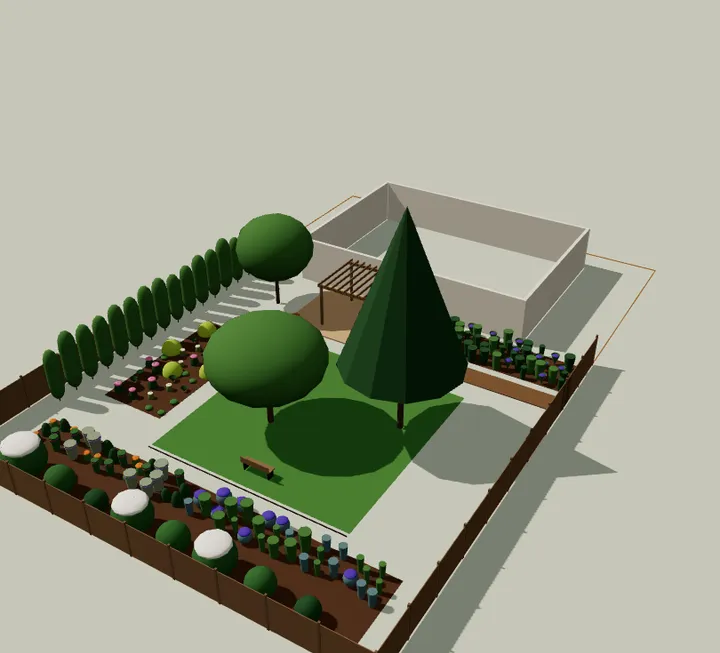
Northeast · Zone 6b
Northeast back yard
Patio with pergola, lawn, privacy hedge, native pollinator border, shade bed and a rain garden.
171 plants · 24 species
Open this sample
Plan a Northeast garden
Set your region, zone and frost dates, then design with the regional palette — the planner checks hardiness, light and moisture as you go.