Designing gardens for the U.S. Southwest
Defaults represent the low and middle Sonoran Desert (around Tucson); Phoenix and Las Vegas are hotter and drier, and Albuquerque, Flagstaff and Santa Fe are several zones colder — set the site zone and frost dates accordingly. Water, heat, alkaline soils and sun intensity drive plant choice.
Southwest gardens are designed around water first. Rain is scarce, arrives in a winter season and a summer monsoon, and evaporates fast. The best desert landscapes look intentional and generous anyway — dappled shade from desert trees, sculptural succulents and long runs of wildflower colour.
Elevation changes everything: a garden in Phoenix and one in Santa Fe share a region but not a palette. Start from your elevation, your soil (often alkaline, sometimes cemented with caliche) and the water you are willing to apply.
Climate
Arid to semi-arid. Low deserts are very hot with rare frost; high deserts have cold winters, intense sun and wide day–night swings. The summer monsoon brings short, intense storms that can erode bare ground.
Hardiness spans roughly zones 7 to 10 across the pilot area. Many desert plants tolerate cold far better than wet: drainage, not temperature, is the most common cause of failure.
Hot desert and semi-arid (Köppen BWh/BSk); very hot summers, mild winters at low elevation, bimodal rain from winter storms and the July–September monsoon. Higher plateaus are much colder.
Design guidance
- Plant in fall (October–November) or late winter; avoid May–June, when heat and dry winds stress new roots.
- Group plants into hydrozones on separate irrigation valves; water deeply and infrequently to build deep roots, and plan to taper irrigation once desert-adapted plants establish.
- Use inorganic mulch (decomposed granite, gravel) around cacti and succulents; reserve organic mulch for shade trees and moister beds.
- Give western and southern exposures heat-tolerant plants and use deciduous trees to shade walls and paving in summer while letting winter sun through.
- Keep spiny agaves and cacti at least 1 m back from walks, play areas and pool decks.
- Saguaro, ocotillo and many other native cacti and trees are protected; buy nursery-grown or permitted salvage plants with tags.
- Fountain grass and buffelgrass carry fire into desert plant communities; use native grasses such as deer grass, big sacaton and blue grama instead.
Design examples
A shade tree courtyard
A desert willow or palo verde gives filtered shade without blocking winter sun. Underplant with Texas sage and red yucca, and edge paths with desert marigold for nearly year-round yellow. Group everything on the same low-water drip zone.
Plants: Desert willow, Blue palo verde, Texas sage, Red yucca, Desert marigold.
A sculptural dry garden
Agave, ocotillo and creosote bush carry the structure; Parry’s penstemon and deer grass soften it. Leave space between plants — desert plantings read best with ground visible — and mulch with gravel or decomposed granite rather than bark.
Plants: Parry's agave, Ocotillo, Creosote bush, Parry's penstemon, Deer grass.
A high-desert grass and wildflower garden
At higher elevations, blue grama makes a low-water lawn alternative, mixed with drought-tolerant wildflowers. It greens up with monsoon rain and goes tawny in winter.
Plants: Blue grama, Desert marigold, Parry's penstemon.
Planting calendar
Windows are anchored to typical frost dates — about February 25 (last spring frost) and November 30 (first fall frost) for the region’s default zone 9a. Your site can differ by weeks.
| When | What |
|---|---|
| Fall (Sep–Nov) | The prime planting season in low deserts: roots establish through the mild winter before summer heat. |
| Winter (Dec–Feb) | Protect frost-tender plants on cold nights in high deserts. Prune most woody plants lightly, if at all. |
| Spring (Mar–Apr) | Second planting window, especially in high deserts after the last frost. Wildflower peak. |
| Summer (May–Aug) | Avoid planting before the monsoon. Water deeply and infrequently; check drip emitters. Monsoon storms can wash out unmulched slopes. |
Cautions
- “Drought tolerant” means after establishment — usually one to three years of supplemental water.
- Bare gravel without shade creates heat islands; use trees and plants to cover ground.
- Several grasses and shrubs sold for desert landscapes, such as fountain grass, are invasive in parts of the Southwest. Check state lists.
Read the full guide: native plants for the Southwest.
Native palette for the Southwest
Plants in the catalog recorded as native to this region, by layer. Native doesn’t mean right for every site — check light, moisture and soil on each plant page.
Trees (5)
- Desert willowChilopsis linearis · 5–8 m (16–26 ft) · draft
- Desert ironwoodOlneya tesota · 5–8 m (16–26 ft) · draft
- Blue palo verdeParkinsonia florida · 6–9 m (20–30 ft) · draft
- Velvet mesquiteProsopis velutina · 6–9 m (20–30 ft) · draft
- Emory oakQuercus emoryi · 6–12 m (20–39 ft) · draft
Conifers (4)
- White firAbies concolor · 9–15 m (30–49 ft) · draft
- Arizona cypressCupressus arizonica · 9–12 m (30–39 ft) · draft
- Colorado blue sprucePicea pungens · 9–15 m (30–49 ft) · draft
- Pinyon pinePinus edulis · 5–10 m (16–33 ft) · draft
Palms (1)
Shrubs (13)
- Four-wing saltbushAtriplex canescens · 1.2–1.8 m (4–6 ft) · draft
- Fairy dusterCalliandra eriophylla · 0.6–1 m (2–3 ft) · draft
- ButtonbushCephalanthus occidentalis · 1.8–3.6 m (6–12 ft) · draft
- Red twig dogwoodCornus sericea · 1.8–2.7 m (6–9 ft) · draft
- Texas mountain laurelDermatophyllum secundiflorum · 3–4.5 m (10–15 ft) · draft
- Hop bushDodonaea viscosa · 2.4–3.6 m (8–12 ft) · draft
- BrittlebushEncelia farinosa · 0.6–1 m (2–3 ft) · draft
- Apache plumeFallugia paradoxa · 0.9–1.8 m (3–6 ft) · draft
- ChuparosaJusticia californica · 0.9–1.5 m (3–5 ft) · draft
- Creosote bushLarrea tridentata · 1.2–2.4 m (4–8 ft) · draft
- JojobaSimmondsia chinensis · 1.2–2.4 m (4–8 ft) · draft
- Yellow bellsTecoma stans · 1.5–3 m (5–10 ft) · draft
- Arizona rosewoodVauquelinia californica · 3–6 m (10–20 ft) · draft
Grasses (6)
- Blue gramaBouteloua gracilis · 0.3–0.6 m (1–2 ft) · draft
- Deer grassMuhlenbergia rigens · 0.9–1.5 m (3–5 ft) · draft
- Mexican feather grassNassella tenuissima · 0.3–0.6 m (1–2 ft) · draft
- Shenandoah switchgrassPanicum virgatum 'Shenandoah' · 0.9–1.2 m (3–4 ft) · draft
- Little bluestemSchizachyrium scoparium · 0.6–1.2 m (2–4 ft) · draft
- Big sacatonSporobolus wrightii · 1.5–2.1 m (5–7 ft) · draft
Perennials (11)
- Common yarrowAchillea millefolium · 0.5–0.9 m (1–3 ft) · draft
- Sunset hyssopAgastache rupestris · 0.5–0.8 m (1–2 ft) · draft
- Butterfly weedAsclepias tuberosa · 0.5–0.8 m (1–2 ft) · draft
- Desert marigoldBaileya multiradiata · 0.3–0.5 m (1 ft) · draft
- California fuchsiaEpilobium canum · 0.3–0.6 m (1–2 ft) · draft
- Cardinal flowerLobelia cardinalis · 0.6–1.2 m (2–4 ft) · draft
- Blackfoot daisyMelampodium leucanthum · 0.2–0.3 m (0–1 ft) · draft
- Wild bergamotMonarda fistulosa · 0.6–1.2 m (2–4 ft) · draft
- Firecracker penstemonPenstemon eatonii · 0.5–0.9 m (1–3 ft) · draft
- Parry's penstemonPenstemon parryi · 0.6–1.2 m (2–4 ft) · draft
- Desert globemallowSphaeralcea ambigua · 0.6–1 m (2–3 ft) · draft
Succulents (9)
- Parry's agaveAgave parryi · 0.5–0.6 m (1–2 ft) · draft
- SaguaroCarnegiea gigantea · 4.5–12 m (15–39 ft) · draft
- Desert spoonDasylirion wheeleri · 0.9–1.5 m (3–5 ft) · draft
- Engelmann's hedgehog cactusEchinocereus engelmannii · 0.2–0.5 m (0–1 ft) · draft
- Fishhook barrel cactusFerocactus wislizeni · 0.6–1.5 m (2–5 ft) · draft
- OcotilloFouquieria splendens · 2.4–4.5 m (8–15 ft) · draft
- Bear grassNolina microcarpa · 0.9–1.2 m (3–4 ft) · draft
- Engelmann prickly pearOpuntia engelmannii · 0.9–1.5 m (3–5 ft) · draft
- Soaptree yuccaYucca elata · 1.8–4.5 m (6–15 ft) · draft
Open the Southwest sample garden
A finished Southwest design built from this palette. It opens in the planner as your own copy — change anything.
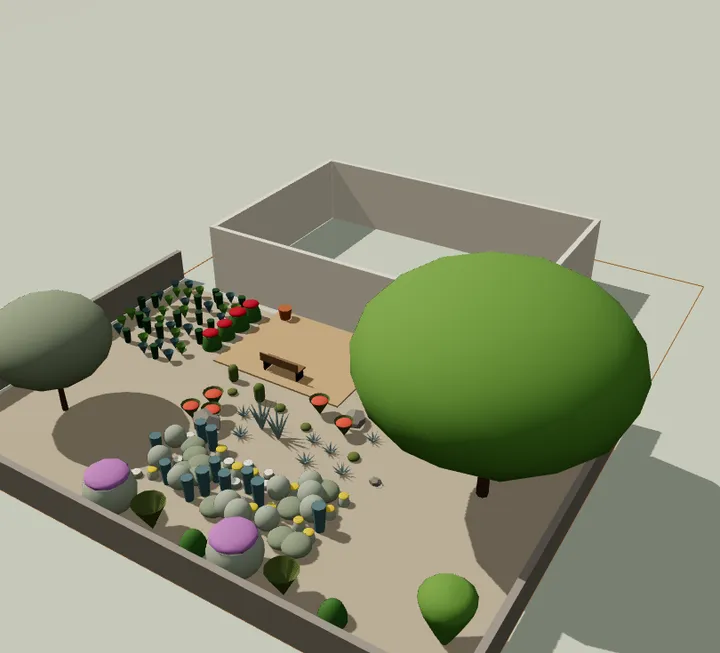
Southwest · Zone 9a
Southwest dry courtyard
Water-wise courtyard: gravel and flagstone, desert trees, agaves and yuccas, a wildflower drift and a basin.
131 plants · 21 species
Open this sample
Plan a Southwest garden
Set your region, zone and frost dates, then design with the regional palette — the planner checks hardiness, light and moisture as you go.