Red yucca
Hesperaloe parviflora (Torr.) J.M.Coult.
Also called red yucca.
Grass-like clump of arching leaves with spineless tips and tall coral flower stalks from spring through fall. Not a true yucca.

Size over time
Typical landscape size 0.6–0.9 m (2–3 ft) tall and 0.6–1.2 m (2–4 ft) wide; slow growth, about 6 years to maturity. Intermediate sizes use the planner’s growth curve (k = 0.12) from the #5 install size.
Bloom
Coral red flowers, Apr–Oct (northern-hemisphere months; timing shifts with region and season).
| Plant | J | F | M | A | M | J | J | A | S | O | N | D |
|---|---|---|---|---|---|---|---|---|---|---|---|---|
| Red yucca : Apr–Oct |
Design notes
- Safe near walks — no sharp spines.
- Deer and rabbits eat flower stalks.
Regions
Native range: Central and west Texas and northeastern Mexico.
Not recorded as native to any of the three pilot regions.
Native status describes where the species occurs naturally. It is not a promise that it suits a particular garden; site conditions decide that.
In the guides
Red yucca comes up in these guides:
Related plants
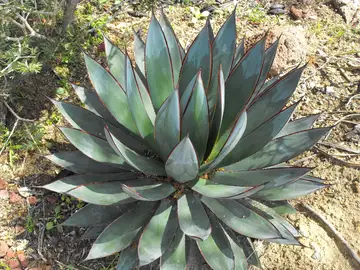 Blue Glow agave Agave 'Blue Glow' · Succulent · 0.3–0.5 m (12–18 in)
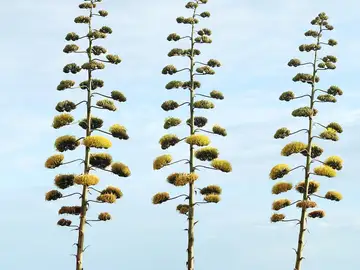 Century plant Agave americana · Succulent · 1.2–1.8 m (4–6 ft)
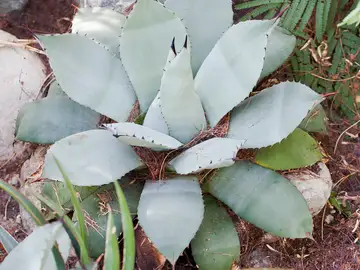 Parry's agave Agave parryi · Succulent · 0.5–0.6 m (18–24 in)
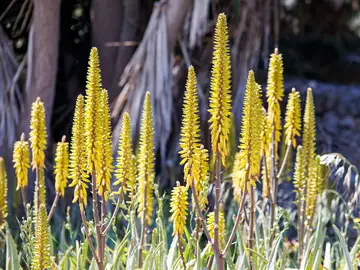 Aloe vera Aloe vera · Succulent · 0.5–0.6 m (18–24 in)
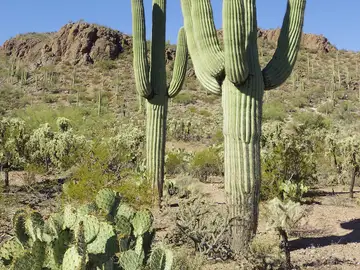 Saguaro Carnegiea gigantea · Succulent · 4.5–12 m (15–39 ft)
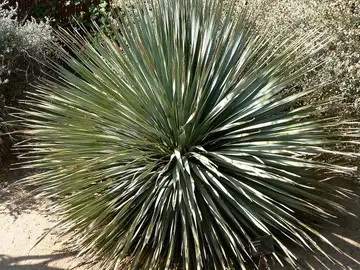 Desert spoon Dasylirion wheeleri · Succulent · 0.9–1.5 m (3–5 ft)
Try Red yucca in a plan
Opens your own copy of a finished sample garden in the planner with Red yucca ready to place; the planner checks it against that garden’s zone, light and moisture.
Plan with Red yucca
Place it in a design, check it against your zone, light and moisture, and see it at year three and year ten.